
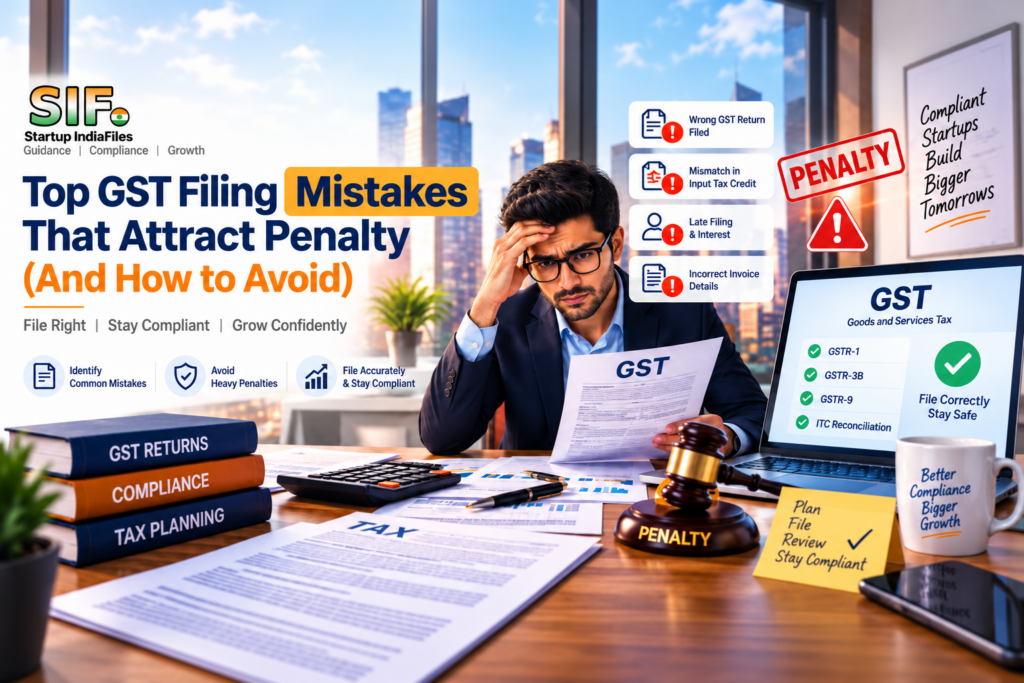
A GST notice rarely arrives because of one big decision. It usually arrives because of a small, repeated error: a credit claimed from an invoice the supplier never uploaded, a wrong tax head on an inter-state sale, or a GSTR-1 that does not match GSTR-3B. With the portal now auto-matching data every month, these GST filing mistakes are detected faster than ever.
The most expensive errors fall into three groups: claiming input tax credit (ITC) you are not entitled to, reporting outward supplies incorrectly, and ignoring document rules such as e-invoicing and e-way bills. Each triggers interest at 18% a year, system notices such as DRC-01B and DRC-01C, and, where tax is short-paid, penalty under Section 74A. Below are twelve mistakes we see most often, with the fix for each.
Why GST Mistakes Are Costlier in 2026
GST enforcement is now largely data-driven. The Invoice Management System (IMS), auto-generated GSTR-2B, e-invoice data from the Invoice Registration Portal (IRP) and e-way bill records are compared against your returns automatically. Differences above set tolerance levels generate a notice without any officer choosing to look at your file.
Two further changes raise the stakes. GSTR-3B Table 3 is hard-locked from the July 2025 tax period, so outward liability can no longer be quietly adjusted in 3B. And demand notices for FY 2024-25 onwards are issued under the new Section 74A, which fixes penalty at 10% of tax or ₹10,000, whichever is higher, in non-fraud cases and 100% of tax where fraud or suppression is alleged.
If you are a founder handling GST yourself alongside fundraising and hiring, this is exactly the area where professional GST return filing pays for itself.
The 12 Most Common GST Filing Mistakes
1. Claiming ITC That Is Not in GSTR-2B
What goes wrong: Credit is claimed on the basis of the purchase register, even though the supplier has not uploaded the invoice or uploaded it late. Section 16(2)(aa) allows ITC only when the invoice appears in your GSTR-2B.
What it triggers: Form DRC-01C when ITC in GSTR-3B exceeds GSTR-2B beyond tolerance, reversal of excess credit, and interest at 18% p.a. on credit wrongly availed and utilised (the notified rate, although Section 50(3) permits up to 24%). If not explained, a demand under Section 74A follows.
Example: You claim ₹1,80,000 ITC while GSTR-2B shows ₹1,50,000. The ₹30,000 gap must be reversed with interest, and if it becomes a demand, penalty will be at least ₹10,000.
Fix: Claim ITC only from GSTR-2B. Keep a list of missing invoices and claim them in the month they appear in 2B, within the Section 16(4) window.
2. Ignoring the Invoice Management System
What goes wrong: Businesses do not open IMS at all. Every supplier invoice left unactioned is deemed accepted when GSTR-2B is generated, including wrong, duplicate or inflated invoices.
What it triggers: Credit on invoices you should have rejected, later reversal with interest, and mismatches with suppliers' credit notes.
Fix: Review IMS before the 14th every month. Reject invoices that are wrong, keep pending those under dispute, and accept only what matches your purchase records.
3. Taking ITC on Blocked Credits Under Section 17(5)
What goes wrong: GST paid on items that the law blocks is claimed as ITC. Common examples are motor vehicles for personal use, food and beverages, club and fitness memberships, personal consumption and construction of immovable property on own account.
What it triggers: Reversal with interest, and penalty under Section 74A if picked up in scrutiny or audit.
Example: A startup pays ₹2,00,000 plus ₹36,000 GST for a corporate gym membership for staff. The ₹36,000 is blocked and cannot be claimed.
Fix: Tag expense ledgers so blocked categories are separated at the booking stage. Our bookkeeping team sets up this tagging during onboarding so the reversal is automatic.
4. Not Reversing ITC When a Supplier Is Unpaid for 180 Days
What goes wrong: Under the second proviso to Section 16(2) read with Rule 37, if you do not pay a supplier the invoice value plus tax within 180 days from the invoice date, the ITC must be reversed.
What it triggers: Reversal with interest from the date the credit was availed. Credit can be re-claimed once payment is made.
Example: Invoice of ₹5,00,000 plus ₹90,000 GST dated 1 March 2026 remains unpaid on 28 August 2026. You must reverse ₹90,000 in GSTR-3B with interest and re-claim it after paying the supplier.
Fix: Run a monthly creditor ageing report. Anything approaching 150 days should be flagged for payment or planned reversal. Tight cash flow management prevents this credit from getting stuck.
5. Missing the ITC Deadline Under Section 16(4)
What goes wrong: Credits missed during the year are forgotten until the annual return. Section 16(4) allows ITC for a financial year only up to 30 November following that year (or the date of filing the annual return, if earlier).
What it triggers: Permanent loss of credit. Any claim after the deadline is disallowed and recovered with interest.
Fix: Reconcile the full year's GSTR-2B against your books in October and claim all eligible pending credit before the cut-off.
6. Charging the Wrong Tax Head: IGST vs CGST + SGST
What goes wrong: Place of supply is determined incorrectly, so an inter-state supply is billed with CGST + SGST, or an intra-state supply with IGST.
What it triggers: The correct tax must be paid again and the wrongly paid tax claimed as a refund under Section 77 of the CGST Act (Section 19 of the IGST Act). Cash stays blocked for months, and the customer's ITC is also disturbed.
Example: A Delhi company supplies services worth ₹1,00,000 to a registered customer in Haryana and charges ₹9,000 CGST + ₹9,000 SGST. It must pay ₹18,000 IGST separately and then apply for a refund of the ₹18,000 paid under the wrong heads.
Fix: Build place-of-supply rules into your invoice template, based on customer GSTIN state code and the nature of supply. Exporters should also keep their IEC registration and LUT details current so zero-rated invoices are raised correctly.
7. Missing Reverse Charge Liability
What goes wrong: Tax payable by the recipient under Section 9(3) or 9(4) is not paid. Frequent examples include legal services from an advocate, goods transport agency services where RCM applies, sponsorship services and import of services such as foreign SaaS subscriptions.
What it triggers: Tax demand with 18% interest and penalty under Section 74A. Since RCM tax is paid in cash, ITC cannot be used to settle it.
Fix: Maintain an RCM checklist of vendor types, and review every foreign invoice and every unregistered vendor bill before filing GSTR-3B.
8. Not Generating E-Invoices When Required
What goes wrong: A business crosses aggregate annual turnover (AATO) of ₹5 crore in any year from FY 2017-18 but continues issuing ordinary invoices for B2B supplies. Separately, taxpayers with AATO of ₹10 crore or more report invoices on the IRP after the 30-day limit.
What it triggers: An invoice without a valid IRN is treated as not issued, so your buyer's ITC is at risk. Penalty under Section 122 for supply without a valid invoice can apply, along with the general penalty of up to ₹25,000 under Section 125.
Fix: Check AATO every April. Once the threshold is crossed, configure your accounting software for e-invoicing and set a rule that no B2B invoice leaves without an IRN.
9. Moving Goods Without an E-Way Bill
What goes wrong: Goods worth more than ₹50,000 are moved without an e-way bill, or with an e-way bill carrying the wrong vehicle number or an expired validity.
What it triggers: Detention of goods and vehicle under Section 129, with release only on payment of penalty that can be as high as 200% of the tax payable where the owner comes forward.
Example: A consignment worth ₹4,00,000 at 18% (₹72,000 GST) is stopped without an e-way bill. The penalty for release can go up to ₹1,44,000.
Fix: Generate the e-way bill at the time of dispatch, update Part B whenever the vehicle changes, and extend validity before it expires.
10. Not Filing Nil Returns
What goes wrong: A newly registered or dormant business assumes no return is needed when there are no sales.
What it triggers: Late fee of ₹20 per day (up to ₹500 per return) for each missed GSTR-1 and GSTR-3B. Continuous non-filing for six months can lead to cancellation of registration by the officer, and returns older than three years become time-barred.
Fix: File nil returns through SMS or the portal every period. If the business is genuinely inactive, apply to cancel registration rather than leaving it dormant. Where registration was cancelled, fresh GST registration support or revocation needs all pending returns cleared first.
11. GSTR-1 and GSTR-3B Not Matching
What goes wrong: Sales reported in GSTR-1 differ from liability paid in GSTR-3B, usually because of invoices added late, credit notes missed or advances not reported.
What it triggers: Form DRC-01B intimation asking you to pay the difference or explain it. With Table 3 hard-locked, 3B now takes figures from GSTR-1, IFF or GSTR-1A, so an error in GSTR-1 flows straight into your tax payment.
Fix: Correct GSTR-1 errors through GSTR-1A before filing GSTR-3B for the same period. Reconcile the sales register, GSTR-1 and e-invoice data every month.
12. Applying Old Rates After GST 2.0
What goes wrong: Since GST 2.0 rate rationalisation took effect on 22 September 2025, most goods and services moved to the 5% and 18% slabs, with 40% for sin and luxury goods. Some businesses still bill using old item masters, especially for slow-moving products.
What it triggers: Short payment where the new rate is higher (demand with interest and Section 74A penalty), or excess tax collected where it is lower, which cannot simply be retained.
Fix: Review HSN/SAC codes and rates in your billing software against the current rate notifications, and test a sample of invoices every quarter.
Penalty Summary Table
| Mistake | Notice / provision | Financial impact |
|---|---|---|
| ITC beyond GSTR-2B | DRC-01C, Section 16(2)(aa) | Reversal + 18% interest |
| Blocked credit claimed | Section 17(5) | Reversal + interest + 74A penalty |
| Supplier unpaid 180 days | Rule 37 | Reversal + interest |
| ITC after 30 November | Section 16(4) | Credit lost permanently |
| Wrong IGST/CGST head | Section 77 CGST / 19 IGST | Pay again, claim refund |
| Reverse charge missed | Section 9(3)/9(4) | Tax + 18% interest + penalty |
| No e-invoice | Sections 122 and 125 | Invalid invoice, penalty |
| No e-way bill | Section 129 | Up to 200% of tax |
| Nil return not filed | Late fee provisions | ₹20/day, max ₹500 |
| GSTR-1 vs 3B gap | DRC-01B | Tax + 18% interest |
| Short tax (non-fraud) | Section 74A | 10% of tax or ₹10,000 |
| Short tax (fraud) | Section 74A | 100% of tax |
Monthly Pre-Filing Checklist
Run this checklist before you submit each return. In our practice, businesses that follow it consistently rarely receive system-generated notices.
- Sales register matches GSTR-1, including credit notes, debit notes and advances.
- Every B2B invoice above the e-invoice threshold carries a valid IRN.
- Tax head (IGST or CGST + SGST) verified against customer state code.
- IMS reviewed: wrong invoices rejected, disputed ones kept pending.
- GSTR-2B reconciled with the purchase register; missing invoices listed for supplier follow-up.
- Blocked credits under Section 17(5) excluded from ITC.
- Creditor ageing checked for invoices unpaid beyond 180 days.
- Reverse charge liability computed for legal, GTA, import of services and other notified supplies.
- HSN/SAC rates checked for any item added or changed during the month.
- GSTR-1A filed for any correction before GSTR-3B is submitted.
- Cash ledger funded for tax, interest and RCM liability.
- Previous month's notices, DRC-01B or DRC-01C intimations answered on the portal.
What to Do If You Have Already Made a Mistake
Correct it at the earliest opportunity. Excess ITC should be reversed voluntarily in GSTR-3B with interest, and short-paid tax can be deposited through Form DRC-03 before a notice is issued. Paying tax and interest before a show cause notice significantly reduces or avoids penalty exposure under Section 74A in non-fraud cases.
If a DRC-01B or DRC-01C intimation has already arrived, reply on the portal within the time given, either by paying the difference or explaining it with a reconciliation. Ignoring these intimations is itself a common reason for escalation to a formal demand. For businesses with turnover large enough to need audited accounts, our statutory audit team can reconcile books with GST data before the annual return.
How Startup India Files Helps You Avoid GST Penalties
- Monthly GSTR-2B, IMS and purchase register reconciliation before every GSTR-3B.
- Blocked-credit, RCM and 180-day ITC checks built into the filing workflow.
- Setup and review of e-invoicing, e-way bill and rate masters after GST 2.0.
- Drafting replies to DRC-01B, DRC-01C and show cause notices.
- Voluntary corrections through GSTR-1A and DRC-03 to minimise interest and penalty.
- A clear monthly summary so founders know exactly what was filed and paid.
We work with startups and SMEs across India from our Delhi office. To get a free review of your last three GST returns, call +91-9971668562 or get in touch with our team.
Frequently Asked Questions
What is the penalty for a wrong GST return?
If an error leads to short payment of tax, you pay the tax with 18% interest, and penalty under Section 74A of 10% of tax or ₹10,000 (whichever is higher) in non-fraud cases. Fraud cases attract 100% of tax.
Can I revise a GST return after filing?
GSTR-3B cannot be revised once filed. Corrections are made in the next period's return, and GSTR-1 errors can be corrected through GSTR-1A before filing GSTR-3B for that period.
What is DRC-01B?
DRC-01B is a system intimation issued when liability in GSTR-1 exceeds tax paid in GSTR-3B beyond the permitted tolerance. You must pay the difference or explain it on the portal.
What is DRC-01C?
DRC-01C is issued when ITC claimed in GSTR-3B exceeds the ITC available in GSTR-2B beyond tolerance. You must reverse the excess or give reasons.
Is there a penalty if I paid the tax before receiving a notice?
In non-fraud cases, paying the tax and interest through DRC-03 before a show cause notice generally avoids penalty. This is why voluntary correction is always better than waiting.
Can a GST mistake lead to cancellation of registration?
Yes, continuous non-filing for six months can lead to cancellation. Serious issues such as claiming ITC without actual supply can also lead to suspension.
Can Startup India Files reply to a GST notice for us?
Yes, our team prepares reconciliations and drafts replies to DRC-01B, DRC-01C and show cause notices, and represents you before the officer where required.
Final Word
Most GST penalties are avoidable. They come from habits, not from the law being unclear: skipping IMS, trusting the purchase register over GSTR-2B, or treating nil returns as optional. A disciplined monthly checklist, supported by clean accounting records, keeps notices, interest and penalty out of your business.
This guide is for general information based on the law as on 22 September 2026. Rules and portal processes change — confirm on the official portal or speak to our team before filing.