
Advance Tax Payment: Due Dates, Calculation & How to Avoid Penalty
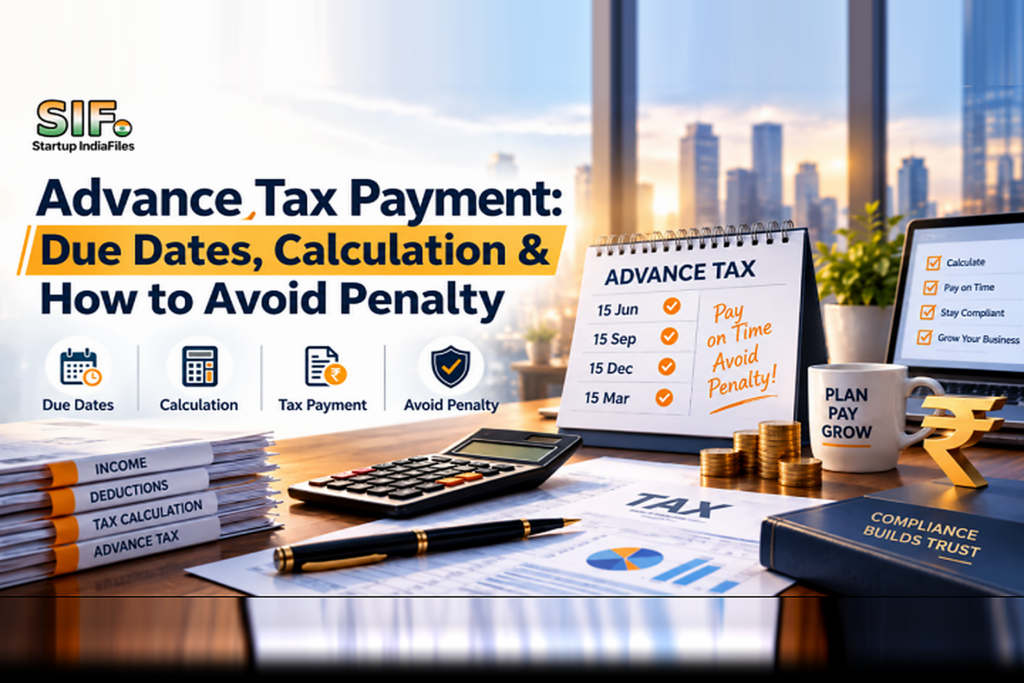
Many business owners discover advance tax only when their return shows a large interest bill they never saw coming. The 15 September 2026 instalment has just passed, and if you did not make an advance tax payment, you are probably wondering how much interest is already building up and what to do next. Advance tax means paying income tax during the year in four instalments rather than in a lump sum at return time. For Tax Year 2026-27, the first under the Income-tax Act, 2025, you must pay if your estimated tax after TDS and TCS is ₹10,000 or more. The cumulative instalments are 15% by 15 June, 45% by 15 September, 75% by 15 December and 100% by 15 March. Missing an instalment attracts 1% monthly interest under Sections 424 and 425. Below we work through the calculation, the interest and the fixes with real ₹ figures. Key Takeaways Tax Year 2026-27 (income from 1 April 2026) is governed by the Income-tax Act, 2025; advance tax is covered by Section 404 (earlier Section 208). The threshold is ₹10,000 of net tax liability after TDS/TCS. Presumptive taxpayers under 44AD/44ADA pay 100% in one instalment by 15 March 2027. If you missed 15 September 2026, pay the shortfall now and catch up fully by 15 December 2026 to limit the damage. Always select “Advance Tax (100)” and Tax Year 2026-27 on the challan. What Is Advance Tax and Why It Matters in 2026 Advance tax is the “pay as you earn” principle applied to income that is not fully covered by TDS — business profits, professional fees, rent, interest, capital gains and so on. The government collects tax through the year instead of waiting for the return. This year is a transition year. The Income-tax Act, 2025 came into force on 1 April 2026, replacing “previous year” and “assessment year” with “tax year”. Advance tax for Tax Year 2026-27 falls under Section 404 of the new Act. Interest for shortfalls is charged under Section 424 (the old Section 234B) and Section 425 (the old Section 234C). Advance tax relating to FY 2025-26 income is still governed by the 1961 Act. If you under-paid that year, Sections 234B and 234C will be computed in the return you are filing now under the 1961 Act. Who Must Pay Advance Tax You are liable if your estimated tax for the year, after reducing TDS and TCS, is ₹10,000 or more. In practice this covers: Proprietors, freelancers and professionals with business or professional income. Partnership firms and LLPs. Companies, including startups that have begun earning profits. Salaried individuals with substantial rent, interest, capital gains or side-business income not covered by their employer’s TDS. Investors with large capital gains or dividend income. The one clear exemption: a resident senior citizen (aged 60 or above) with no income from business or profession need not pay advance tax, and can pay the entire tax as self-assessment tax before filing. Advance Tax Due Dates for Tax Year 2026-27 Due date Cumulative amount payable Status on 22 Sep 2026 15 June 2026 15% of estimated tax Passed 15 September 2026 45% of estimated tax Just passed 15 December 2026 75% of estimated tax Upcoming 15 March 2027 100% of estimated tax Upcoming 15 March 2027 (44AD/44ADA) 100% in one instalment Upcoming Any tax paid by 31 March 2027 is still treated as advance tax for the year, although interest under Section 425 may apply to the March instalment if it is paid after 15 March. How to Calculate Advance Tax: A Worked Example Let us take a business owner who runs a proprietorship with regular books and has opted for the new regime. The calculation below uses the current new regime slabs (nil up to ₹4 lakh, then 5%, 10%, 15%, 20% and 25% in ₹4 lakh bands, and 30% above ₹24 lakh). Confirm the slabs applicable to Tax Year 2026-27 before finalising your own estimate. Step 1: Estimate Total Income Particulars Amount Estimated business profit ₹28,00,000 Interest on fixed deposits ₹2,00,000 Estimated total income ₹30,00,000 The standard deduction does not apply here because there is no salary income. Step 2: Compute Tax Under the New Regime Income slab Rate Tax Up to ₹4,00,000 Nil ₹0 ₹4,00,001 – ₹8,00,000 5% ₹20,000 ₹8,00,001 – ₹12,00,000 10% ₹40,000 ₹12,00,001 – ₹16,00,000 15% ₹60,000 ₹16,00,001 – ₹20,00,000 20% ₹80,000 ₹20,00,001 – ₹24,00,000 25% ₹1,00,000 ₹24,00,001 – ₹30,00,000 30% ₹1,80,000 Tax on slabs ₹4,80,000 Add: cess at 4% ₹19,200 Total tax ₹4,99,200 No surcharge applies because income is below ₹50 lakh, and no rebate is available because income is above ₹12 lakh. Step 3: Reduce TDS and Arrive at Net Advance Tax Assume the bank will deduct ₹20,000 TDS on the FD interest (10% of ₹2 lakh) and customers will deduct ₹29,200 TDS on contract and professional payments. Total TDS is ₹49,200. Net advance tax payable = ₹4,99,200 − ₹49,200 = ₹4,50,000. Because this exceeds ₹10,000, advance tax applies. Step 4: Split Into Instalments Due date Cumulative % Cumulative amount Instalment to pay 15 June 2026 15% ₹67,500 ₹67,500 15 September 2026 45% ₹2,02,500 ₹1,35,000 15 December 2026 75% ₹3,37,500 ₹1,35,000 15 March 2027 100% ₹4,50,000 ₹1,12,500 The four instalments add up to ₹4,50,000. Revisit the estimate before each due date. If business picks up in the second half, increase the December and March instalments accordingly. Accurate monthly accounting is what makes these mid-year re-estimates reliable. Interest on Missed or Short Payment: Sections 425 and 424 Section 425: Deferment of Instalments Section 425 charges simple interest at 1% per month on the shortfall in each instalment — for 3 months on the June, September and December instalments, and for 1 month on the March instalment. There is relief for the first two instalments: no interest arises if you have paid at least 12% by 15 June and 36% by 15 September. Scenario A — September missed. Our business owner paid ₹67,500 in June but nothing by 15 September. The required cumulative amount was
Advance Tax Payment: Due Dates, Calculation & How to Avoid Penalty Read More »