Uncategorized

Private Limited Company vs LLP

Private Limited Company vs LLP

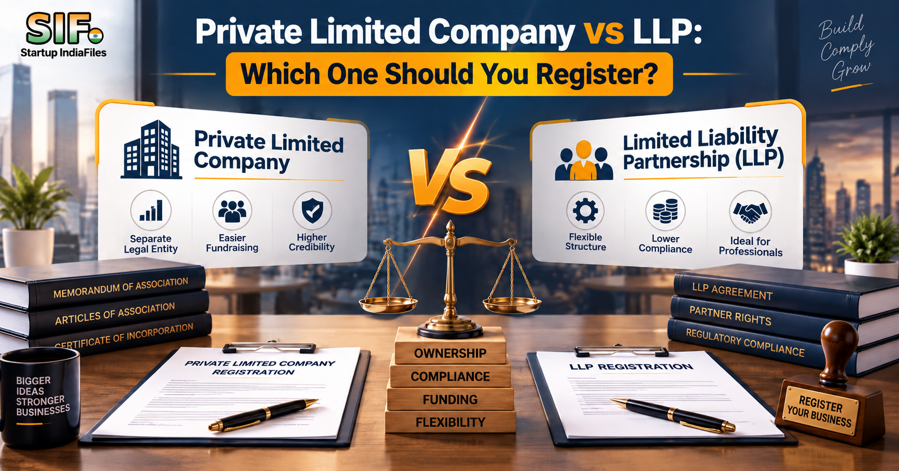
Private Limited Company vs LLP You have a business idea, a co-founder and a bank account waiting to be opened, and every advisor gives you a different answer on structure. The private limited company vs LLP question is the one we are asked most often, because the choice decides how much tax you pay, how much compliance you carry and whether an investor will write you a cheque. The short answer: choose a Private Limited Company if you plan to raise equity funding, issue ESOPs or scale fast. Choose an LLP if you are a small team of partners running a profitable services business with no plan to bring in outside investors. Key Takeaways Both structures are separate legal entities with limited liability, and both are eligible for DPIIT startup recognition . A Private Limited Company pays 22% base tax under the concessional regime (about 25.17% effective), against 30% plus cess for an LLP, but dividends are taxed again in shareholders’ hands. LLP profit share is exempt in partners’ hands, so for owner-run businesses that distribute all profits, an LLP often costs less in total tax. LLPs cannot issue equity shares or ESOPs, which is why venture investors almost always insist on a company. An LLP needs an audit only above ₹40 lakh turnover or ₹25 lakh contribution, while a company needs a statutory audit every year. What Each Structure Actually Is A Private Limited Company is incorporated under the Companies Act, 2013 through the SPICe+ (INC-32) form on the MCA V3 portal. It needs at least two directors, one of whom must be resident in India, and at least two shareholders, with a maximum of 200 members. There is no minimum capital, and the name must end with “Private Limited”. Ownership is held through shares, which can be transferred, pledged and issued to investors. A Limited Liability Partnership is registered under the LLP Act, 2008 through the FiLLiP form on the MCA portal. It needs at least two designated partners, with at least one resident in India, and there is no upper limit on the number of partners. Ownership is expressed as a contribution and profit-sharing ratio set out in the LLP Agreement, which must be filed in Form 3 within 30 days of incorporation. Private Limited Company vs LLP: Side-by-Side Comparison Parameter Private Limited Company LLP Governing law Companies Act, 2013 LLP Act, 2008 Minimum members 2 directors, 2 shareholders 2 designated partners Maximum members 200 No limit Liability Limited to unpaid share capital Limited to agreed contribution Incorporation form SPICe+ (INC-32) FiLLiP + Form 3 Statutory audit Mandatory every year Only above ₹40 lakh turnover or ₹25 lakh contribution Annual MCA filings AOC-4, MGT-7/7A, ADT-1, DIR-3 KYC, others Form 11, Form 8 Board meetings / AGM Required Not required Base income tax 22% concessional or 25% / 30% 30% Tax on distribution Dividend taxed in shareholder’s hands Profit share exempt for partners Equity funding Yes, shares of any class No equity shares ESOPs Allowed Not allowed DPIIT recognition Eligible Eligible How Profits Are Taxed: The Worked ₹ Example The following example uses a business with ₹30 lakh net profit before any payment to founders and no other adjustments. Rates Used Private Limited Company – concessional regime: 22% base tax, plus 10% surcharge and 4% health and education cess. Effective rate: 25.168%. Private Limited Company – normal regime: 25% base tax with 4% cess where applicable in this example. Effective rate: 26%. LLP: 30% base tax plus 4% cess in this example. Effective rate: 31.2%. If you want help calculating and filing your actual business tax, see our Corporate Income Tax Preparation & Filing Service . Funding, ESOPs and Foreign Investment If there is a reasonable possibility of raising angel or venture capital, a Private Limited Company is generally the structure used because investors can subscribe to equity or convertible preference shares. An LLP cannot issue equity shares or operate a conventional ESOP scheme. Foreign investment can also be more restrictive for LLPs compared with companies depending on the sector and applicable FDI conditions. Annual Compliance Calendar Compared Compliance is one of the biggest running differences between the two structures. For ongoing ROC, MCA and statutory filing support, see our Compliance & Regulatory Services . Startup India Recognition and the Tax Holiday Both a Private Limited Company and an LLP can qualify for DPIIT startup recognition , subject to applicable eligibility conditions. Both structures can also potentially claim the startup tax holiday where all statutory conditions and certification requirements are satisfied. Choose an LLP If… You are a group of professionals or partners running a services business. You intend to distribute most profits every year. You have no plans for external equity investment. You want to reduce ongoing compliance requirements. You want flexibility to set profit-sharing ratios independently of capital. You want limited liability without board meetings and AGMs. If this structure fits your business model, you can start with our LLP Registration Service . How Startup India Files Helps You Choose and Register the Right Entity One-to-one structuring support to compare company and LLP tax outcomes. End-to-end incorporation through SPICe+ or FiLLiP . First-year compliance setup and filing assistance . Ongoing ROC filings, accounting and income tax return support . DPIIT recognition and startup tax holiday application assistance. Not sure which structure fits? Call CA Gaurav Gulati’s team on +91-9971668562 or contact the team with your business plan for a numbers-based comparison. Frequently Asked Questions Is an LLP cheaper than a Private Limited Company? An LLP is usually cheaper to run because it has fewer recurring compliance requirements and may not require an audit below the applicable thresholds. Registration costs are broadly comparable. Which pays less income tax, a company or an LLP? A company can pay less tax at the entity level, while an LLP may become more tax-efficient where most post-tax profits are distributed to partners. For individual calculations, see our Corporate Income Tax Filing Service . Can an LLP raise funding from investors?

Private Limited Company vs LLP Read More »

DPIIT Recognition Kaise Milti Hai? Eligibility & Benefits Guide

DPIIT Recognition Kaise Milti Hai? Eligibility & Benefits Guide DPIIT Recognition Kaise Milti Hai? Eligibility & Benefits Guide Founders usually ask us two questions in the same breath: “Do we even qualify?” and “Is it worth the effort?” The answers changed in February 2026, when the government rewrote the startup definition, raised the turnover ceiling and created a separate track for deep-tech companies. Many businesses that were shut out earlier now qualify. In short, DPIIT recognition is the government’s official certification that your entity is a “startup”. You qualify if you are a Private Limited Company, OPC, LLP, registered partnership firm or cooperative society, are not more than 10 years old (20 for deep tech), have never crossed ₹200 crore turnover in a year (₹300 crore for deep tech), and are building something innovative or scalable. In return you get access to a profit-linked tax holiday, IP fee rebates, procurement relaxations, government-backed funding and lighter compliance. Key takeaways DPIIT notification G.S.R. 108(E) dated 4 February 2026 replaced the 19 February 2019 notification and is now the governing rule. The turnover limit doubled from ₹100 crore to ₹200 crore; a new Deep Tech Startup category allows 20 years and ₹300 crore. Cooperative societies became eligible for the first time; proprietorships and HUFs still are not. The tax holiday gives a 100% profit deduction for 3 consecutive years out of 10, but only to companies and LLPs with IMB certification. Recognition is not permanent. It ends when the age or turnover limit is crossed. What DPIIT Recognition Is and Why It Matters The Department for Promotion of Industry and Internal Trade (DPIIT) under the Ministry of Commerce and Industry runs the Startup India programme. Recognition is a certificate with a unique number that confirms your entity meets the statutory definition of a startup. Almost every startup concession in India is tied to that certificate: the tax holiday, SIPP patent and trademark rebates, public procurement relaxations, Seed Fund Scheme support and startup-friendly insolvency provisions. Investors and incubators also use it as a basic screening filter. The 2026 Notification: What Changed G.S.R. 108(E) is the first comprehensive rewrite of the startup definition since 2019. The changes reflect how Indian startups have grown: companies take longer to mature, especially in hardware and science-led sectors, and revenue milestones are larger. Criterion 2019 notification 2026 notification (G.S.R. 108(E)) Maximum age 10 years 10 years Turnover ceiling ₹100 crore in any FY ₹200 crore in any FY Deep tech track Not available 20 years, ₹300 crore Eligible entities Company, LLP, registered firm Adds cooperative societies Reconstructed businesses Not eligible Not eligible Innovation or scalability test Required Required The practical effect is significant. A company that crossed ₹100 crore turnover a couple of years ago and lost its status can now re-examine eligibility under the new ceiling, as long as it has never crossed ₹200 crore and is within the age limit. Regular Startup vs Deep Tech Startup The Deep Tech Startup category recognises that sectors like semiconductors or biotech need longer R&D cycles before revenue arrives. It covers areas such as artificial intelligence, semiconductors, space, biotechnology, quantum technologies, robotics, advanced materials and clean energy. | | Feature Regular startup Deep Tech Startup Age limit from incorporation Up to 10 years Up to 20 years Turnover ceiling ₹200 crore ₹300 crore Core test Innovation or scalable model Science or engineering-led technology Extra documentation Not required Proof of R&D and technology Typical evidence Deck, website, product demo Patents, research papers, lab data, R&D spend In our practice we often see companies claim “deep tech” simply because they use an AI API in their app. That is unlikely to pass. The category is for businesses whose core value comes from their own research, engineering or technology development, and the application should prove it with documents. Which Entities Are Eligible | | Entity type Eligible? Remarks Private Limited Company Yes Best fit for funding and tax holiday One Person Company Yes Treated as a private company LLP Yes Eligible for tax holiday too Registered Partnership Firm Yes Must be registered with Registrar of Firms Cooperative Society (state / multi-state) Yes New from February 2026 Sole Proprietorship No Must convert or incorporate HUF No Not an eligible form Unregistered Partnership Firm No Register the firm first Solo founders who want recognition without a co-founder can use OPC registration, which qualifies as a private company. For family or professional partnerships, getting the firm formally registered through proper partnership firm registration is a precondition; an unregistered deed does not count. The Conditions, One by One Age Count from the date of incorporation or registration, not from when you started trading. A company incorporated on 15 June 2017 remains within the 10-year window until 14 June 2027. Turnover The test is “in any financial year since incorporation”. One year above ₹200 crore (₹300 crore for deep tech) is enough to disqualify, even if turnover later falls. Innovation or scalability The entity must work towards innovation, development or improvement of products, processes or services, or have a scalable business model with high potential for employment generation or wealth creation. Pure trading, reselling or a routine service business rarely clears this test without a clear differentiator. Not a reconstruction An entity formed by splitting up or reconstructing an existing business is not eligible. Moving an established proprietorship’s customers and assets into a new company to claim startup status is the classic example that fails. The Benefits in Depth 1. The startup tax holiday The biggest financial benefit is the startup tax holiday (Section 80-IAC under the 1961 Act, carried forward under the Income-tax Act, 2025). An eligible startup can deduct 100% of its profits from business for any 3 consecutive years out of the first 10 years from incorporation. The conditions are strict: Only Private Limited Companies (including OPCs) and LLPs qualify. The entity must be incorporated before 1 April 2030. It needs a separate certificate from the Inter-Ministerial Board (IMB); DPIIT recognition alone is not enough.

DPIIT Recognition Kaise Milti Hai? Eligibility & Benefits Guide Read More »

Startup India Registration: Eligibility, Documents & Process

Startup India Registration: Eligibility, Documents & Process Startup India Registration: Eligibility, Documents & Process Most founders hear about Startup India registration from an investor, an incubator or a friend who got a tax holiday, and then find a portal full of forms, drop-downs and a free-text box asking them to “describe the innovation”. A weak answer in that box, or the wrong entity type, is enough to get the application sent back. Here is the short answer. Startup India registration means getting your company, LLP, registered partnership firm or cooperative society recognised as a startup by DPIIT through the Startup India portal on the National Single Window System (NSWS). It is free, fully online and usually decided within a few working days to a few weeks, provided the entity is under 10 years old, has never crossed ₹200 crore turnover in any financial year, and can show genuine innovation or scalability. Key takeaways Registration is a two-stage journey: incorporate an eligible entity on mca.gov.in first, then apply for DPIIT recognition on startupindia.gov.in / NSWS. The eligibility rules now come from DPIIT notification G.S.R. 108(E) dated 4 February 2026, which replaced the 2019 notification. There is no government fee; the real effort goes into the innovation write-up and clean documents. Recognition does not automatically give you the income-tax holiday. That needs a separate Inter-Ministerial Board (IMB) certification. The most common reason for rejection is a vague or generic description of the business. What Startup India Registration Actually Means Startup India is the Government of India’s programme to support new businesses with tax, compliance, IPR and funding benefits. “Registration” on the portal is only a user profile. The legally meaningful step is DPIIT recognition, which results in a certificate with a unique recognition number. Investors, incubators, tender desks and the IP office ask for that certificate; without it, startup-specific concessions are not available. Who Can Register in 2026 Under G.S.R. 108(E), an entity qualifies as a startup if it meets all of these conditions: It is incorporated or registered in India as a Private Limited Company (including an OPC), an LLP, a registered Partnership Firm, or a state or multi-state cooperative society. Not more than 10 years have passed since incorporation (20 years for the new Deep Tech Startup category). Turnover has not exceeded ₹200 crore in any financial year since incorporation (₹300 crore for Deep Tech). It is working towards innovation, development or improvement of products, processes or services, or has a scalable business model with high potential for employment generation or wealth creation. It was not formed by splitting up or reconstructing an existing business. Sole proprietorships, HUFs and unregistered partnership firms cannot apply. We have kept this section brief on purpose; our separate guide on DPIIT eligibility and benefits explains the 2026 changes, the Deep Tech category and each benefit in depth. Step 1: Choose the Right Entity Before You Apply The entity you choose decides not just eligibility but which benefits you can actually use later. The startup tax holiday, for example, is available only to Private Limited Companies and LLPs, not to partnership firms or cooperatives. Entity DPIIT eligible Tax holiday eligible Investor preference Private Limited Company Yes Yes Highest One Person Company Yes Yes Low until converted LLP Yes Yes Moderate Registered Partnership Firm Yes No Low Cooperative Society Yes (new in 2026) No Not typical Sole Proprietorship No No Not applicable In our practice we often see founders pick an LLP to save on compliance and convert a year later. If equity funding or ESOPs are on the roadmap, private limited company incorporation from day one is usually cheaper overall. Service-led founders who want lower compliance and do not need equity investors can look at LLP registration instead. Step 2: Incorporate the Entity on MCA For a Private Limited Company, incorporation happens on the MCA V3 portal through SPICe+ (INC-32). Part A reserves the name; Part B carries the e-MoA (INC-33), e-AoA (INC-34) and AGILE-PRO-S (INC-35). Directors need a DSC, and DINs are allotted through the same form. PAN and TAN are issued along with the Certificate of Incorporation. With clean documents, the whole process typically takes 7 to 15 working days. Before incorporating, co-founders should agree equity split, vesting and exit terms in writing. A well-drafted founders agreement also helps later, because the DPIIT form asks for director details and investors will ask how the team is bound together. Step 3: Create Your Profile on Startup India / NSWS Once the Certificate of Incorporation is in hand, go to startupindia.gov.in (which routes to the National Single Window System for the recognition application). Sign up with the authorised representative’s name, email and mobile number, and verify the OTP. Choose the user type as “Startup” and complete the basic profile: entity name, stage (ideation, validation, early traction or scaling) and sector. From the dashboard, open the DPIIT recognition application on NSWS. Step 4: Fill the DPIIT Recognition Form, Field by Field Portal labels change from time to time, but the substance stays the same. Entity details Nature of entity, entity name exactly as on the incorporation certificate, CIN/LLPIN or registration number, date of incorporation and entity PAN. Any mismatch between these fields and the MCA master data is a frequent cause of clarification requests. Industry, sector and categories Pick the industry and sector that match your actual revenue model, not an aspirational one. A SaaS product for restaurants belongs under IT services / enterprise software, not under food and beverages. Registered office and authorised representative Registered office address as filed with MCA, and the name, designation, mobile and email of the person who will handle communication. Use an email that someone actually checks, because DPIIT’s queries arrive there. Directors or partners Name, gender, DIN/DPIN or PAN, Aadhaar, mobile and email for each director or partner. For a cooperative society, details of the key office bearers. Startup information Whether you are incubated, have received funding, hold or have applied for IP, or have won awards. Each

Startup India Registration: Eligibility, Documents & Process Read More »

difference between accounting and bookkeeping

Difference Between Accounting and Bookkeeping Explained Simply

Difference Between Accounting and Bookkeeping Explained Simply Accounting and bookkeeping are often confused as the same thing, but they serve different purposes in business finance. Both play an important role in managing money, tracking performance, and staying compliant with tax laws. Bookkeeping focuses on recording daily financial transactions, while accounting uses that recorded data to analyze business performance and support decision-making. For startups and small businesses, understanding this difference helps in organizing finances properly and planning future growth. Basis Bookkeeping Accounting Meaning Recording daily financial transactions Analyzing and interpreting financial data Purpose Maintain accurate financial records Help in business decision-making Main Task Entry of sales, expenses, invoices, payments Preparing reports, tax planning, financial analysis Level of Work Basic and routine Advanced and strategic Skills Required Data entry and record management Financial knowledge and compliance expertise Output Organized transaction records Profit & loss statement, balance sheet, cash flow Role in Business Tracks what happened Explains what it means Timing Done daily or regularly Done monthly, quarterly, or yearly Used By Bookkeepers Accountants Business Impact Keeps records clean Guides growth and financial planning

Difference Between Accounting and Bookkeeping Explained Simply Read More »

common accounting mistakes startups

Avoid These Startup Accounting Mistakes

Common Accounting Mistakes Startups Make (And How to Avoid Them) Starting a business is exciting, but many startups unknowingly damage their growth by ignoring basic accounting practices. Financial mistakes don’t always show immediate impact — they slowly build up and later appear as cash shortages, compliance issues, or poor business decisions. Proper accounting is not just about tax filing; it plays a major role in managing expenses, tracking profits, and planning future growth. Unfortunately, many founders focus heavily on operations and marketing while leaving finance as an afterthought. Below are some of the most common accounting mistakes startups make and practical ways to avoid them. Mixing Personal and Business Finances One of the biggest accounting mistakes startups make is using personal bank accounts for business transactions. This creates confusion while tracking income and expenses, making it difficult to understand actual business performance. When personal and business finances are mixed, preparing financial statements becomes complicated and tax filing becomes risky. It also reduces professional credibility, especially when dealing with investors or banks. Many founders follow this approach initially to save effort, but it leads to messy records later. To avoid this mistake, open a separate current account for your startup from day one. Route all business income and expenses through this account only. This simple step helps maintain transparency, improves financial discipline, and makes compliance much easier. Ignoring Proper Bookkeeping and Record Maintenance Many startups delay bookkeeping until the end of the financial year, assuming they can organize everything later. This approach often results in missing invoices, untracked expenses, and inaccurate records. Without proper bookkeeping, founders cannot analyze profitability, control spending, or plan budgets effectively. It also becomes extremely stressful during tax season when documents are scattered. Consistent bookkeeping provides a clear picture of financial health and supports smarter decision-making. Startups should maintain monthly records of income, expenses, bank statements, and invoices using accounting software or professional support. Regular updates prevent errors, save time, and ensure that financial reports are always ready when needed. Missing GST and Income Tax Deadlines Tax compliance is another area where startups frequently struggle. Missing GST returns or income tax filing deadlines results in penalties, interest, and unnecessary notices from authorities. Some businesses also delay GST registration even after crossing eligibility limits, which can lead to legal trouble. These compliance issues not only increase financial burden but also damage business credibility. To avoid this, startups should maintain a compliance calendar listing all filing dates and statutory requirements. Setting reminders or working with an accounting professional ensures timely submissions. Staying compliant from the beginning builds trust with clients, vendors, and financial institutions while protecting the business from avoidable legal complications. Poor Cash Flow Management Many startups focus only on revenue and ignore cash flow, which is a dangerous mistake. Even profitable businesses can fail if cash is not available to pay salaries, vendors, or operational expenses. Irregular client payments, unplanned spending, and lack of financial forecasting often lead to cash shortages. Founders sometimes realize the problem only when accounts run dry. To prevent this, startups should actively monitor cash inflows and outflows on a weekly basis. Creating cash flow projections, maintaining emergency reserves, and controlling unnecessary expenses help stabilize finances. Proper cash flow management ensures smooth operations and gives startups the flexibility to handle unexpected challenges. Skipping Professional Accounting Support Trying to handle accounting without professional help is common among early-stage startups looking to save costs. While this may work temporarily, incorrect filings, miscalculations, and compliance errors often end up costing more later. Accounting involves technical knowledge of taxation laws, reporting standards, and regulatory requirements that founders may not fully understand. A small mistake can lead to penalties or legal issues. Investing in professional accounting support helps startups avoid these risks. Accountants provide accurate bookkeeping, timely filings, and financial guidance, allowing founders to focus on business growth while staying compliant. Final Thoughts Strong accounting practices create a strong business foundation. Startups that avoid these common mistakes gain better control over finances, improve decision-making, and build long-term stability. Financial discipline from the beginning prevents future stress and supports sustainable growth. By separating finances, maintaining proper records, staying compliant, managing cash flow wisely, and seeking professional help, startups can protect themselves from costly errors. Accounting may not feel exciting, but it is one of the most important pillars of startup success.

Avoid These Startup Accounting Mistakes Read More »

why every startup needs

Accounting & Compliance for Growing Startups

Why Every Startup Needs Proper Accounting and Compliance Support Starting a business is exciting, but managing finances and legal compliance can quickly become overwhelming. Many startups focus mainly on sales and growth, while accounting and compliance are handled at the last minute. This often leads to confusion, penalties, and poor financial decisions. Proper accounting is the backbone of every successful business. When your books are clean and updated, you clearly understand your income, expenses, and cash flow. This clarity helps founders plan budgets, control costs, and make confident decisions. Clean Accounting Builds Financial Confidence Accurate bookkeeping ensures that every transaction is recorded correctly. With structured accounting, startups can: Track real profitability Monitor cash flow regularly Avoid accounting errors Prepare financial statements easily Clean records also make tax filing and audits much smoother. Compliance Prevents Costly Mistakes GST, Income Tax, TDS, and ROC compliances come with strict deadlines. Missing filings or submitting incorrect data can result in penalties and notices. A proper compliance system helps businesses: Meet all regulatory deadlines Maintain proper documentation Reduce legal risks Stay audit-ready Timely compliance protects your business reputation and finances. MIS Reports Help You Grow Smarter Management Information System (MIS) reports turn financial data into actionable insights. Monthly or quarterly MIS shows performance trends, expense patterns, and profit margins, helping founders identify opportunities and control losses early. Why Professional Support Matters Hiring a full-time finance team is expensive for early-stage businesses. Professional accounting and compliance services provide expert support at a fraction of the cost, giving startups access to experienced guidance without heavy overhead. Final Thoughts Accounting and compliance are not just legal requirements — they are powerful tools for business growth. With clean books, timely filings, and meaningful reports, startups can reduce risks, improve cash flow, and focus on building a successful future.

Accounting & Compliance for Growing Startups Read More »

blog 1

What Is GST Planning?

What Is GST Planning and Why Is It Important for Businesses? GST planning is the process of managing Goods and Services Tax in a structured and legally compliant way to reduce tax burden, improve cash flow, and avoid penalties. It is not about avoiding tax — it is about paying the correct tax at the correct time with proper documentation. For startups, SMEs, and growing businesses, GST planning plays a major role in maintaining financial discipline and smooth operations. Key Areas of GST Planning Effective GST planning focuses on accurate reporting and timely compliance. Businesses should regularly monitor their GST activities to prevent errors and notices. Proper GST registration and compliance setup Correct classification of goods and services Accurate invoicing and Input Tax Credit (ITC) tracking Timely filing of GST returns (GSTR-1, GSTR-3B, etc.) Regular reconciliation of sales and purchase data Why GST Planning Matters Without proper GST management, businesses may face penalties, interest charges, mismatch notices, and loss of eligible Input Tax Credit. Structured GST planning helps companies stay prepared and financially stable. Benefits include: Improved cash flow management Maximum utilization of Input Tax Credit Reduced compliance risk Smooth audits and assessments Role of Professional GST Support Professional GST planning ensures correct documentation, advance tax estimation, and timely filings. Experts also assist with reconciliations and quick responses to GST notices, helping businesses avoid last-minute stress and remain compliance-ready throughout the year.

What Is GST Planning? Read More »

Call Email WhatsApp