
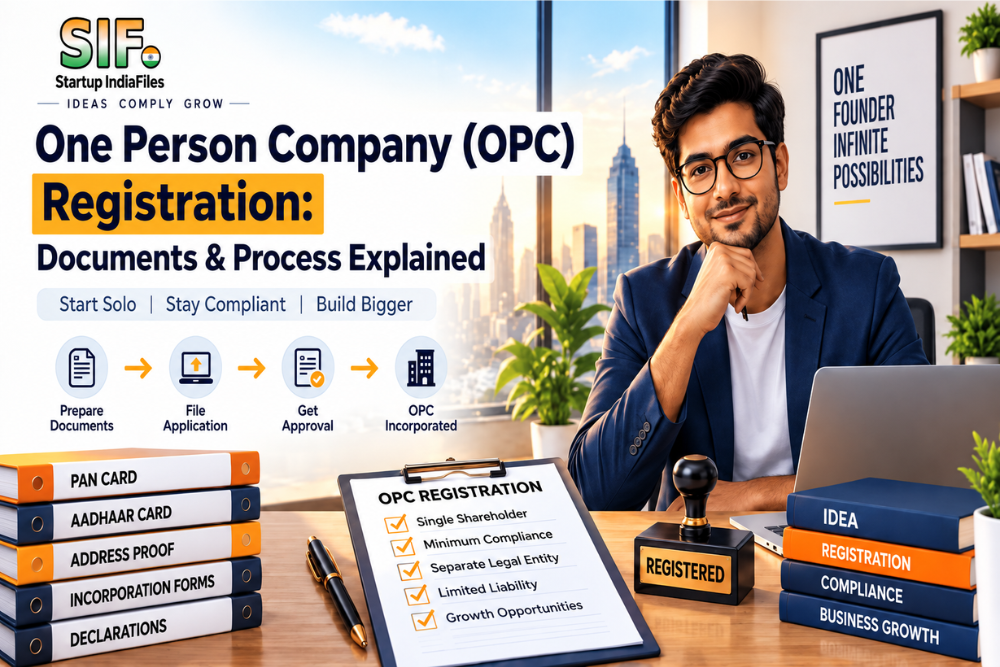
You are a solo founder. You want the credibility and limited liability of a company, but you do not have a co-founder, and adding a relative as a token director feels wrong. Running as a sole proprietor keeps your personal savings exposed to every business debt.
OPC registration solves exactly this. A One Person Company lets a single Indian citizen own and run a private limited company with just one member and a nominee. It is incorporated online through SPICe+ on the MCA V3 portal, usually within 7–15 working days when documents are clean, and it receives its PAN and TAN along with the Certificate of Incorporation.
Key Takeaways
- An OPC has one member, who must be a natural person, an Indian citizen and resident in India (120 days or more in the previous financial year).
- A nominee is mandatory, and their consent is filed in Form INC-3.
- Since 1 April 2021, there is no forced conversion when capital or turnover grows; you can convert to a Private Limited Company voluntarily at any time.
- An OPC needs no AGM and no cash flow statement, but statutory audit, AOC-4, MGT-7A and ITR-6 still apply.
- An OPC is eligible for DPIIT startup recognition as a private company.
What Is a One Person Company?
A One Person Company is defined in Section 2(62) of the Companies Act, 2013 as a company with only one person as a member. Legally, it is a private company. It has its own PAN, can own property, can sue and be sued, and continues even if the member dies, because the nominee steps in.
The name must end with "(OPC) Private Limited". An OPC needs at least one director (the member can be the sole director) and can have up to 15 directors. There is no minimum paid-up capital requirement.
In our practice we often see freelancers, consultants, software developers and small traders move to an OPC once their annual billing crosses a level where clients start asking for a company invoice, or where the owner wants to separate personal and business risk.
Who Can Register an OPC? Eligibility Rules for 2026
- Member: Only a natural person who is an Indian citizen and resident in India. Resident here means stayed in India for at least 120 days in the previous financial year, a relaxation made in 2021 from the earlier 182 days. This allows NRIs who are Indian citizens and meet the 120-day test to form an OPC.
- Nominee: Must also be a natural person, an Indian citizen and resident in India. The nominee gives written consent in Form INC-3.
- One OPC per person: A person can be a member of only one OPC at a time, and can be a nominee in only one OPC.
- Minors: A minor cannot be a member or nominee of an OPC.
- Restricted activities: An OPC cannot be incorporated as a Section 8 (non-profit) company and cannot carry out non-banking financial investment activities.
- Companies and LLPs cannot be members of an OPC; only individuals can.
OPC vs Sole Proprietorship vs Private Limited Company
| Parameter | Sole Proprietorship | OPC | Private Limited |
|---|---|---|---|
| Owners | 1 | 1 member + nominee | 2 to 200 |
| Legal entity | Not separate | Separate | Separate |
| Liability | Unlimited | Limited | Limited |
| Registration | No single law | SPICe+ on MCA | SPICe+ on MCA |
| Income tax | Slab rates | Company rates | Company rates |
| Statutory audit | Only if 44AB applies | Mandatory | Mandatory |
| AGM | Not applicable | Not required | Required |
| Equity funding | Not possible | Limited | Easy |
| DPIIT eligible | No | Yes | Yes |
| Continuity | Ends with owner | Nominee takes over | Perpetual |
A sole proprietorship is still the fastest way to start testing an idea, but it gives no liability protection and is not eligible for DPIIT recognition. A Private Limited Company is better when you have a co-founder or plan to raise investor money. The OPC sits in between.
Documents Required for OPC Registration
All documents should be clear scans. Address proofs such as bank statements or utility bills must not be older than two months at the time of filing.
| Document | Member | Nominee | Registered Office |
|---|---|---|---|
| PAN card | Required | Required | Not applicable |
| Aadhaar card | Required | Required | Not applicable |
| Passport-size photograph | Required | Required | Not applicable |
| Address proof (bank statement or utility bill, 2 months) | Required | Required | Not applicable |
| Email ID and mobile number | Required | Required | Not applicable |
| Digital Signature Certificate | Required | Not required | Not applicable |
| Consent in Form INC-3 | Not applicable | Required | Not applicable |
| Utility bill (not older than 2 months) | Not applicable | Not applicable | Required |
| NOC from property owner | Not applicable | Not applicable | Required |
| Rent agreement (if rented) | Not applicable | Not applicable | Required |
For NRI members, the passport is required, and documents executed abroad generally need notarisation or apostille depending on the country. If the office is in a family-owned home, the NOC comes from the family member who owns it, along with their ownership or utility proof.
In our practice we often see filings returned because the name on the PAN does not exactly match the Aadhaar, or because the utility bill is three months old. Fix these before you start, not after.
Step-by-Step OPC Registration Process on SPICe+
- Obtain a DSC for the proposed director and member. The DSC is used to sign the SPICe+ forms online.
- Choose and reserve the name through SPICe+ Part A on the MCA V3 portal. Give up to two proposed names ending in "(OPC) Private Limited". Once approved, the name is reserved for 20 days, within which Part B must be filed.
- Draft the MoA and AoA in the web forms e-MoA (INC-33) and e-AoA (INC-34). The object clause should clearly describe your business so that banks and GST officers understand it. Our MoA and AoA drafting team tailors the object clause rather than copying a template.
- Fill SPICe+ Part B with details of the member, nominee, director, registered office, capital and shareholding. The DIN for the first director is allotted through this form.
- Attach the nominee's INC-3 along with KYC of the member and nominee, office proof and the NOC.
- Complete AGILE-PRO-S (INC-35) for EPFO, ESIC, bank account and, optionally, GSTIN. Proposed draft rules published by MCA in April 2026 would make some AGILE-PRO-S registrations optional, but these are not yet final.
- Sign and certify the forms with the DSCs of the member and director, and get them certified by a practising CA, CS or CMA.
- Pay the fees and submit. The Central Registration Centre examines the application and may raise a resubmission query.
- Receive the Certificate of Incorporation with the CIN, along with the company's PAN and TAN.
Once incorporated, the OPC's bank account can be opened through the AGILE-PRO-S bank option or directly. We also help with current account opening at a bank that suits your transaction volume.
Timeline and Government Cost Components
With complete documents, OPC registration typically takes 7–15 working days. The steps that add time are DSC issuance (usually a day or two), name approval (a few working days, longer if the name is objected to), and resubmission queries from the CRC.
We do not quote a single all-in fee because government charges vary by state and capital. The cost components are:
- DSC charges for the director and member, paid to a certifying authority.
- Name reservation fee through SPICe+ Part A.
- SPICe+ filing fee, linked to the authorised capital of the OPC.
- Stamp duty on the MoA and AoA, which is state-specific and depends on authorised capital and the state of the registered office.
- Professional fees for drafting, filing and certification.
In our experience, keeping authorised capital at a modest level in the beginning keeps stamp duty low; it can be increased later by filing SH-7 when funds are actually needed.
Post-Incorporation Compliance Checklist for an OPC
Incorporation is the beginning. An OPC has lighter compliance than a regular private company, but not zero compliance.
- First auditor: Appoint within 30 days of incorporation and file ADT-1.
- INC-20A: File the declaration of commencement of business within 180 days, after the member deposits the subscription money in the company's bank account.
- Board meetings: At least one in each half of the calendar year, with a gap of at least 90 days between them. This does not apply if the OPC has only one director.
- Statutory audit: Mandatory every year, regardless of turnover.
- AOC-4: File financial statements within 180 days of the end of the financial year. OPCs are exempt from preparing a cash flow statement.
- MGT-7A: File the abridged annual return every year. No AGM is required.
- DIR-3 KYC: Each director with a DIN must complete KYC as per the current MCA cycle.
- ITR-6: File the company's income tax return, due 31 October where audit applies.
- DPT-3 and MSME-1: File where applicable.
- GST, TDS and payroll: Apply for GST registration if you cross the threshold or supply goods inter-state, and file TDS returns if you deduct tax on rent, salary or professional fees.
An OPC is taxed like any other domestic company: 22% under the concessional regime (about 25.17% effective with surcharge and cess), or 25% for companies with turnover up to ₹400 crore without the concessional option. For example, an OPC with ₹12 lakh taxable profit under the 22% regime pays ₹3,02,016 (₹2,64,000 base tax, plus ₹26,400 surcharge, plus ₹11,616 cess). A proprietor with the same ₹12 lakh income and no other income pays nil under the new regime because of the rebate. This is why an OPC makes financial sense when profits are higher or when liability protection matters more than tax.
Keeping clean books from the first month makes the year-end audit painless. Our bookkeeping services are built for single-owner companies, and we manage the full calendar of MCA compliance filings for OPCs.
Conversion Rules: When and How an OPC Can Change
The Companies (Incorporation) Second Amendment Rules, 2021, effective 1 April 2021, removed the old rule that forced an OPC to convert when paid-up capital crossed ₹50 lakh or average turnover crossed ₹2 crore. The minimum two-year wait before voluntary conversion was also removed.
- OPC to Private or Public Company: Voluntary conversion at any time. Increase members to at least two (seven for a public company) and directors to at least two (three for public), pass a special resolution, alter the MoA and AoA, and file MGT-14 and INC-6 with the ROC.
- Private Company to OPC: A private company, other than a Section 8 company, can convert into an OPC by reducing its members to one, passing a special resolution, obtaining creditors' consent and filing INC-6.
- Change of nominee: The member can change the nominee at any time by filing INC-4, and the nominee can withdraw consent by giving notice.
In our practice, founders usually convert when they bring in a co-founder or an angel investor, since equity funding needs more than one shareholder.
DPIIT Recognition for an OPC
As a private company, an OPC is eligible for Startup India recognition under DPIIT Gazette Notification G.S.R. 108(E) dated 4 February 2026, provided it is up to 10 years old, turnover has not exceeded ₹200 crore in any financial year, and the business works towards innovation or a scalable model. The application is free on NSWS / startupindia.gov.in. Our Startup India registration support focuses on the innovation write-up, which is the most common reason for rejection.
Common Mistakes in OPC Registration
- Proposing a name without "(OPC) Private Limited" or one too similar to an existing company or trademark.
- Choosing a nominee who is a non-resident or already a nominee in another OPC.
- Using address proofs older than two months or mismatched spellings across PAN, Aadhaar and bank records.
- Copying a generic object clause that does not describe the actual business, which later creates problems with banks and GST officers.
- Forgetting INC-20A within 180 days, which can lead to penalties and strike-off action.
- Assuming "no AGM" means "no annual filings" and missing AOC-4 or MGT-7A.
How Startup India Files Helps You With OPC Registration
- Eligibility check for the member and nominee, including the 120-day residency test for NRIs.
- DSC, name search and SPICe+ Part A filing with backup names.
- Custom e-MoA and e-AoA, INC-3 and complete SPICe+ Part B filing through to the Certificate of Incorporation.
- First-year set-up: auditor appointment, INC-20A, bank account and GST where needed.
- An annual compliance package covering accounting, audit coordination, AOC-4, MGT-7A and ITR-6.
- Conversion support when you add a co-founder or investor.
Ready to start? Call CA Gaurav Gulati's team on +91-9971668562, or begin with our OPC registration service and we will send you a document checklist the same day.
Frequently Asked Questions
Can an NRI register a One Person Company?
Yes, if the NRI is an Indian citizen who stayed in India for at least 120 days in the previous financial year. Foreign nationals cannot be members of an OPC.
Who can be a nominee in an OPC?
Any natural person who is an Indian citizen and resident in India, and not a minor. Their consent is filed in Form INC-3, and a person can be a nominee in only one OPC.
Is there a minimum capital for OPC registration?
No. There is no minimum paid-up capital. Government fees and stamp duty depend on the authorised capital you choose.
Does an OPC need a statutory audit?
Yes. Every OPC must get its accounts audited every year, whatever its turnover, and file AOC-4 within 180 days of the financial year end.
Must an OPC convert into a Private Limited Company after crossing ₹2 crore turnover?
No. Since 1 April 2021 there is no compulsory conversion based on capital or turnover. Conversion is now voluntary.
How long does OPC registration take?
Typically 7–15 working days with complete documents, including DSC, name approval and SPICe+ processing.
Does Startup India Files handle the complete OPC process?
Yes. We manage everything from DSC and name approval to the Certificate of Incorporation, bank account and first-year compliance, with a single point of contact.
Final Word
For a solo founder who wants limited liability, a company's credibility and a clean path to a Private Limited Company later, an OPC is the right starting point. Prepare clean KYC for yourself and your nominee, draft a precise object clause, and plan your first-year filings from day one.
This guide is for general information based on the law as on 22 September 2026. Rules and portal processes change — confirm on the official portal or speak to our team before filing.