
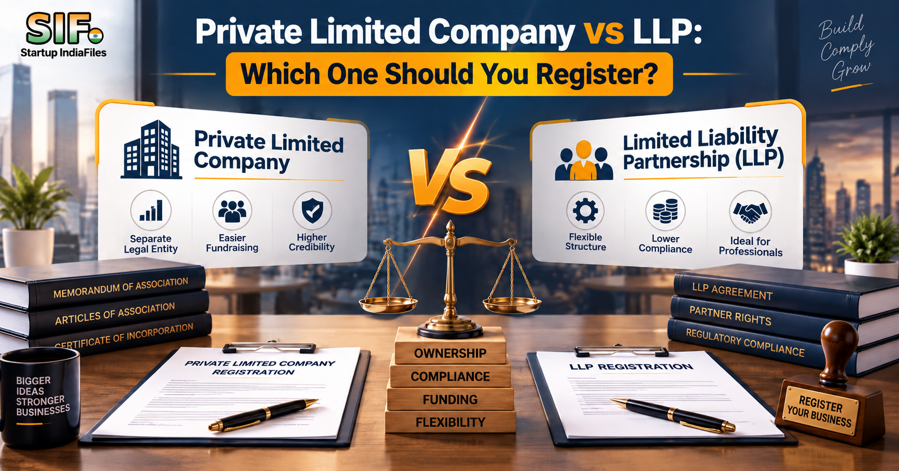
Private Limited Company vs LLP
You have a business idea, a co-founder and a bank account waiting to be opened, and every advisor gives you a different answer on structure. The private limited company vs LLP question is the one we are asked most often, because the choice decides how much tax you pay, how much compliance you carry and whether an investor will write you a cheque.
The short answer: choose a Private Limited Company if you plan to raise equity funding, issue ESOPs or scale fast. Choose an LLP if you are a small team of partners running a profitable services business with no plan to bring in outside investors.
Both structures give limited liability. The main differences lie in funding options, compliance costs and how profits are taxed when they are taken out of the business.
Key Takeaways
- Both structures are separate legal entities with limited liability, and both are eligible for DPIIT startup recognition.
- A Private Limited Company pays 22% base tax under the concessional regime (about 25.17% effective), against 30% plus cess for an LLP, but dividends are taxed again in shareholders' hands.
- LLP profit share is exempt in partners' hands, so for owner-run businesses that distribute all profits, an LLP often costs less in total tax.
- LLPs cannot issue equity shares or ESOPs, which is why venture investors almost always insist on a company.
- An LLP needs an audit only above ₹40 lakh turnover or ₹25 lakh contribution, while a company needs a statutory audit every year.
What Each Structure Actually Is
A Private Limited Company is incorporated under the Companies Act, 2013 through the SPICe+ (INC-32) form on the MCA V3 portal. It needs at least two directors, one of whom must be resident in India, and at least two shareholders, with a maximum of 200 members.
There is no minimum capital, and the name must end with “Private Limited”. Ownership is held through shares, which can be transferred, pledged and issued to investors.
A Limited Liability Partnership is registered under the LLP Act, 2008 through the FiLLiP form on the MCA portal. It needs at least two designated partners, with at least one resident in India, and there is no upper limit on the number of partners.
Ownership is expressed as a contribution and profit-sharing ratio set out in the LLP Agreement, which must be filed in Form 3 within 30 days of incorporation.
Private Limited Company vs LLP: Side-by-Side Comparison
| Parameter | Private Limited Company | LLP |
|---|---|---|
| Governing law | Companies Act, 2013 | LLP Act, 2008 |
| Minimum members | 2 directors, 2 shareholders | 2 designated partners |
| Maximum members | 200 | No limit |
| Liability | Limited to unpaid share capital | Limited to agreed contribution |
| Incorporation form | SPICe+ (INC-32) | FiLLiP + Form 3 |
| Statutory audit | Mandatory every year | Only above ₹40 lakh turnover or ₹25 lakh contribution |
| Annual MCA filings | AOC-4, MGT-7/7A, ADT-1, DIR-3 KYC, others | Form 11, Form 8 |
| Board meetings / AGM | Required | Not required |
| Base income tax | 22% concessional or 25% / 30% | 30% |
| Tax on distribution | Dividend taxed in shareholder's hands | Profit share exempt for partners |
| Equity funding | Yes, shares of any class | No equity shares |
| ESOPs | Allowed | Not allowed |
| FDI | Automatic route in most sectors | Only where 100% automatic, no conditions |
| Setup and running cost | Higher | Lower |
| Exit / transfer | Transfer shares | Change partners through LLP Agreement |
| DPIIT recognition | Eligible | Eligible |
| Startup tax holiday | Eligible | Eligible |
Liability, Ownership and Exit
Liability is limited in both cases. A shareholder risks only the unpaid amount on shares; a partner risks only the agreed contribution, except in cases of fraud or wrongful acts, where personal liability can follow.
The real difference is how ownership moves. In a company, a founder can sell shares to another person, and a new investor can subscribe to fresh shares.
In an LLP, admitting or exiting a partner means amending the LLP Agreement and filing Form 3 and Form 4 with MCA. It works well for a stable group of partners, but becomes less convenient when ownership changes frequently.
How Profits Are Taxed: The Worked ₹ Example
The following example uses a business with ₹30 lakh net profit before any payment to founders and no other adjustments.
Rates Used
- Private Limited Company – concessional regime: 22% base tax, plus 10% surcharge and 4% health and education cess. Effective rate: 25.168%.
- Private Limited Company – normal regime: 25% base tax with 4% cess where applicable in this example. Effective rate: 26%.
- LLP: 30% base tax plus 4% cess in this example. Effective rate: 31.2%.
Scenario A: All ₹30 Lakh Retained in the Entity
| Item | Pvt Ltd – 22% Regime | Pvt Ltd – 25% Regime | LLP |
|---|---|---|---|
| Taxable profit | ₹30,00,000 | ₹30,00,000 | ₹30,00,000 |
| Base tax | ₹6,60,000 | ₹7,50,000 | ₹9,00,000 |
| Surcharge | ₹66,000 | Nil | Nil |
| Cess at 4% | ₹29,040 | ₹30,000 | ₹36,000 |
| Total tax | ₹7,55,040 | ₹7,80,000 | ₹9,36,000 |
| Profit after tax | ₹22,44,960 | ₹22,20,000 | ₹20,64,000 |
At the entity level, the company saves ₹1,80,960 compared with the LLP. If profits are being reinvested into the business, this difference can matter.
Scenario B: Profits Taken Home by the Founders
Assume the company pays the entire ₹22,44,960 as dividend to a founder whose income already falls in the 30% slab. Using 30% plus 4% cess and ignoring surcharge for simplicity, dividend tax would be approximately ₹7,00,428.
Total tax on the ₹30 lakh would therefore become approximately ₹14,55,468. For an LLP, partners' share of post-tax profit is exempt in their hands in the example, leaving total tax at ₹9,36,000.
Scenario C: Founders Draw Remuneration
Suppose ₹12 lakh is paid in total to two founders, leaving ₹18 lakh taxable in the entity.
- Company: total entity-level tax in the example is ₹4,53,024.
- LLP: total entity-level tax in the example is ₹5,61,600.
The remuneration received by founders is taxed at personal slab rates. Partner remuneration in an LLP is deductible only where the LLP Agreement authorises it and applicable limits are followed.
Funding, ESOPs and Foreign Investment
If there is a reasonable possibility of raising angel or venture capital, a Private Limited Company is generally the structure used because investors can subscribe to equity or convertible preference shares.
An LLP cannot issue equity shares or operate a conventional ESOP scheme. Foreign investment can also be more restrictive for LLPs compared with companies depending on the sector and applicable FDI conditions.
Annual Compliance Calendar Compared
| Compliance | Private Limited Company | LLP |
|---|---|---|
| Board meetings | 4 a year, or 2 for qualifying small companies | Not required |
| Statutory audit | Every year | Only above applicable thresholds |
| AGM | By 30 September | Not required |
| Financial statements | AOC-4 within 30 days of AGM | Form 8 by 30 October |
| Annual return | MGT-7 / MGT-7A within 60 days of AGM | Form 11 by 30 May |
| Director / Partner KYC | DIR-3 KYC | DIR-3 KYC for designated partners |
| Deposit return | DPT-3 by 30 June | Not applicable |
| Income tax return | ITR-6 | ITR-5 |
| Late fee on MCA forms | Additional fee as applicable | ₹100 per day per form, no cap |
Startup India Recognition and the Tax Holiday
Both a Private Limited Company and an LLP can qualify for DPIIT startup recognition, subject to applicable eligibility conditions.
Both structures can also potentially claim the startup tax holiday where all statutory conditions and certification requirements are satisfied.
Cost of Setting Up and Running
Setup costs for both structures can include DSCs, name reservation, MCA filing fees, state stamp duty and professional fees.
The larger difference is usually in ongoing compliance. A company generally incurs costs for statutory audit, board and AGM documentation and additional MCA filings, while a qualifying small LLP may avoid the mandatory audit cost.
Choose a Private Limited Company If…
- You plan to raise angel, VC or institutional funding.
- You want to offer ESOPs to employees or advisors.
- You expect foreign investors or a foreign parent company.
- You intend to reinvest most profits rather than distribute them.
- You want to bid for large corporate or government contracts.
- You may want to list or be acquired in future.
Choose an LLP If…
- You are a group of professionals or partners running a services business.
- You intend to distribute most profits every year.
- You have no plans for external equity investment.
- You want to reduce ongoing compliance requirements.
- You want flexibility to set profit-sharing ratios independently of capital.
- You want limited liability without board meetings and AGMs.
Converting Later: What Are Your Options?
LLP to Private Limited Company
An LLP can convert into a company under Section 366 of the Companies Act, 2013 by filing Form URC-1 along with the required incorporation documents. Applicable tax consequences should be reviewed before proceeding.
Private Limited Company to LLP
A company can convert into an LLP under the applicable provisions of the LLP Act, subject to statutory requirements. Tax neutrality is available only where prescribed conditions are satisfied.
Conversion can involve additional time, documentation and cost, so choosing the appropriate structure at the beginning can simplify future operations.
How Startup India Files Helps You Choose and Register the Right Entity
- One-to-one structuring support to compare company and LLP tax outcomes.
- End-to-end incorporation through SPICe+ or FiLLiP.
- DSC, name approval, MoA/AoA or LLP Agreement support.
- First-year compliance setup and filing assistance.
- Ongoing ROC filings, accounting and income tax return support.
- DPIIT recognition and startup tax holiday application assistance.
- Conversion support where business requirements change.
Not sure which structure fits?
Call CA Gaurav Gulati's team on +91-9971668562 or contact the team with your business plan for a numbers-based comparison.
Frequently Asked Questions
Is an LLP cheaper than a Private Limited Company?
An LLP is usually cheaper to run because it has fewer recurring compliance requirements and may not require an audit below the applicable thresholds. Registration costs are broadly comparable.
Which pays less income tax, a company or an LLP?
A company can pay less tax at the entity level, while an LLP may become more tax-efficient where most post-tax profits are distributed to partners.
Can an LLP raise funding from investors?
An LLP can accept capital contributions from new partners, but it cannot issue equity shares or conventional ESOPs. This makes it less suitable for many angel and VC funding structures.
Can a single founder form an LLP or a Private Limited Company?
Both normally require at least two members. A solo founder seeking limited liability may consider a One Person Company where eligible.
Are both structures eligible for Startup India recognition?
Yes, both Private Limited Companies and LLPs can qualify subject to the applicable DPIIT eligibility conditions.
Can I convert my LLP into a company later?
Yes. An LLP can be converted into a company through the prescribed legal process, subject to documentation, consent and applicable tax considerations.
How does Startup India Files decide which structure to recommend?
The comparison considers funding plans, expected profit distribution, number of founders, foreign investment requirements, tax impact and ongoing compliance costs.
Final Word
There is no universally better structure; the right choice depends on your business plans. If equity funding, ESOPs or foreign investment are part of your roadmap, a Private Limited Company may suit that model better.
If you are running a stable partner-led business and expect to distribute most profits, an LLP may offer a simpler compliance structure and different tax treatment.