
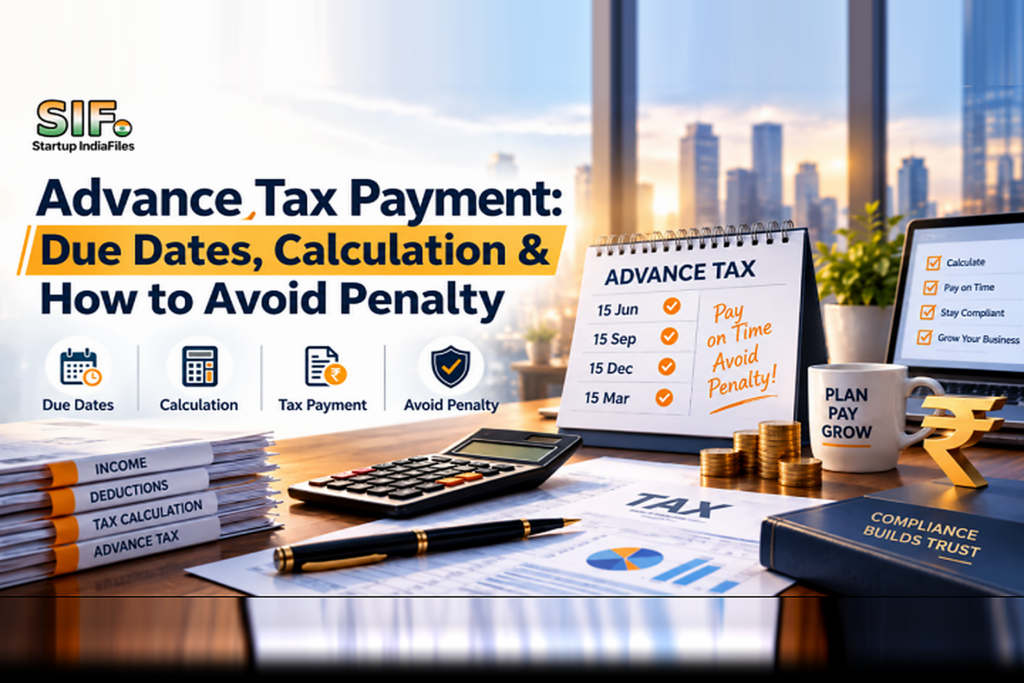
Many business owners discover advance tax only when their return shows a large interest bill they never saw coming. The 15 September 2026 instalment has just passed, and if you did not make an advance tax payment, you are probably wondering how much interest is already building up and what to do next.
Advance tax means paying income tax during the year in four instalments rather than in a lump sum at return time. For Tax Year 2026-27, the first under the Income-tax Act, 2025, you must pay if your estimated tax after TDS and TCS is ₹10,000 or more. The cumulative instalments are 15% by 15 June, 45% by 15 September, 75% by 15 December and 100% by 15 March. Missing an instalment attracts 1% monthly interest under Sections 424 and 425. Below we work through the calculation, the interest and the fixes with real ₹ figures.
Key Takeaways
- Tax Year 2026-27 (income from 1 April 2026) is governed by the Income-tax Act, 2025; advance tax is covered by Section 404 (earlier Section 208).
- The threshold is ₹10,000 of net tax liability after TDS/TCS.
- Presumptive taxpayers under 44AD/44ADA pay 100% in one instalment by 15 March 2027.
- If you missed 15 September 2026, pay the shortfall now and catch up fully by 15 December 2026 to limit the damage.
- Always select "Advance Tax (100)" and Tax Year 2026-27 on the challan.
What Is Advance Tax and Why It Matters in 2026
Advance tax is the "pay as you earn" principle applied to income that is not fully covered by TDS — business profits, professional fees, rent, interest, capital gains and so on. The government collects tax through the year instead of waiting for the return.
This year is a transition year. The Income-tax Act, 2025 came into force on 1 April 2026, replacing "previous year" and "assessment year" with "tax year". Advance tax for Tax Year 2026-27 falls under Section 404 of the new Act. Interest for shortfalls is charged under Section 424 (the old Section 234B) and Section 425 (the old Section 234C).
Advance tax relating to FY 2025-26 income is still governed by the 1961 Act. If you under-paid that year, Sections 234B and 234C will be computed in the return you are filing now under the 1961 Act.
Who Must Pay Advance Tax
You are liable if your estimated tax for the year, after reducing TDS and TCS, is ₹10,000 or more. In practice this covers:
- Proprietors, freelancers and professionals with business or professional income.
- Partnership firms and LLPs.
- Companies, including startups that have begun earning profits.
- Salaried individuals with substantial rent, interest, capital gains or side-business income not covered by their employer's TDS.
- Investors with large capital gains or dividend income.
The one clear exemption: a resident senior citizen (aged 60 or above) with no income from business or profession need not pay advance tax, and can pay the entire tax as self-assessment tax before filing.
Advance Tax Due Dates for Tax Year 2026-27
| Due date | Cumulative amount payable | Status on 22 Sep 2026 |
|---|---|---|
| 15 June 2026 | 15% of estimated tax | Passed |
| 15 September 2026 | 45% of estimated tax | Just passed |
| 15 December 2026 | 75% of estimated tax | Upcoming |
| 15 March 2027 | 100% of estimated tax | Upcoming |
| 15 March 2027 (44AD/44ADA) | 100% in one instalment | Upcoming |
Any tax paid by 31 March 2027 is still treated as advance tax for the year, although interest under Section 425 may apply to the March instalment if it is paid after 15 March.
How to Calculate Advance Tax: A Worked Example
Let us take a business owner who runs a proprietorship with regular books and has opted for the new regime. The calculation below uses the current new regime slabs (nil up to ₹4 lakh, then 5%, 10%, 15%, 20% and 25% in ₹4 lakh bands, and 30% above ₹24 lakh). Confirm the slabs applicable to Tax Year 2026-27 before finalising your own estimate.
Step 1: Estimate Total Income
| Particulars | Amount |
|---|---|
| Estimated business profit | ₹28,00,000 |
| Interest on fixed deposits | ₹2,00,000 |
| Estimated total income | ₹30,00,000 |
The standard deduction does not apply here because there is no salary income.
Step 2: Compute Tax Under the New Regime
| Income slab | Rate | Tax |
|---|---|---|
| Up to ₹4,00,000 | Nil | ₹0 |
| ₹4,00,001 – ₹8,00,000 | 5% | ₹20,000 |
| ₹8,00,001 – ₹12,00,000 | 10% | ₹40,000 |
| ₹12,00,001 – ₹16,00,000 | 15% | ₹60,000 |
| ₹16,00,001 – ₹20,00,000 | 20% | ₹80,000 |
| ₹20,00,001 – ₹24,00,000 | 25% | ₹1,00,000 |
| ₹24,00,001 – ₹30,00,000 | 30% | ₹1,80,000 |
| Tax on slabs | ₹4,80,000 | |
| Add: cess at 4% | ₹19,200 | |
| Total tax | ₹4,99,200 |
No surcharge applies because income is below ₹50 lakh, and no rebate is available because income is above ₹12 lakh.
Step 3: Reduce TDS and Arrive at Net Advance Tax
Assume the bank will deduct ₹20,000 TDS on the FD interest (10% of ₹2 lakh) and customers will deduct ₹29,200 TDS on contract and professional payments. Total TDS is ₹49,200.
Net advance tax payable = ₹4,99,200 − ₹49,200 = ₹4,50,000. Because this exceeds ₹10,000, advance tax applies.
Step 4: Split Into Instalments
| Due date | Cumulative % | Cumulative amount | Instalment to pay |
|---|---|---|---|
| 15 June 2026 | 15% | ₹67,500 | ₹67,500 |
| 15 September 2026 | 45% | ₹2,02,500 | ₹1,35,000 |
| 15 December 2026 | 75% | ₹3,37,500 | ₹1,35,000 |
| 15 March 2027 | 100% | ₹4,50,000 | ₹1,12,500 |
The four instalments add up to ₹4,50,000. Revisit the estimate before each due date. If business picks up in the second half, increase the December and March instalments accordingly. Accurate monthly accounting is what makes these mid-year re-estimates reliable.
Interest on Missed or Short Payment: Sections 425 and 424
Section 425: Deferment of Instalments
Section 425 charges simple interest at 1% per month on the shortfall in each instalment — for 3 months on the June, September and December instalments, and for 1 month on the March instalment. There is relief for the first two instalments: no interest arises if you have paid at least 12% by 15 June and 36% by 15 September.
Scenario A — September missed. Our business owner paid ₹67,500 in June but nothing by 15 September. The required cumulative amount was ₹2,02,500, and even the relief threshold of 36% (₹1,62,000) was not met.
- Shortfall on 15 September: ₹2,02,500 − ₹67,500 = ₹1,35,000
- Interest: ₹1,35,000 × 1% × 3 months = ₹4,050
If they catch up by paying ₹2,70,000 by 15 December (taking the cumulative total to ₹3,37,500) and the balance by 15 March, the Section 425 interest stays at ₹4,050.
Scenario B — June and September both missed.
- June shortfall ₹67,500 × 1% × 3 = ₹2,025
- September shortfall ₹2,02,500 × 1% × 3 = ₹6,075
- Total Section 425 interest: ₹8,100
Section 424: Shortfall at Year End
Section 424 applies if advance tax paid by 31 March is less than 90% of the assessed tax. Interest is 1% per month (a part month counts as a full month) on the unpaid amount from 1 April until the date of payment.
Scenario C. Suppose our business owner paid only ₹3,37,500 by 31 March 2027 against assessed tax of ₹4,50,000. 90% of ₹4,50,000 is ₹4,05,000, so the payment falls short.
- Unpaid amount: ₹4,50,000 − ₹3,37,500 = ₹1,12,500
- Paid as self-assessment tax on 25 July 2027: April to July = 4 months
- Section 424 interest: ₹1,12,500 × 1% × 4 = ₹4,500
- Section 425 interest on the March instalment: ₹1,12,500 × 1% × 1 = ₹1,125
Total interest of ₹5,625 on a tax bill that could have been paid on time. The amounts look modest here, but they scale with your tax — at a ₹20 lakh liability, the same pattern would cost around ₹25,000.
Missed the 15 September 2026 Instalment? Do This Now
The September instalment has just passed. Here is what we advise clients:
- Pay the shortfall immediately. Section 425 interest for September is fixed at three months regardless, but paying now reduces cash stress in December and protects you from Section 424.
- Re-estimate your income using actual figures for April–August plus a realistic projection for the remaining months.
- Plan for the full 75% by 15 December 2026. Clearing the cumulative December target means no further deferment interest for that instalment.
- If a capital gain arose after 15 September, pay the tax on it in the remaining instalments; no deferment interest applies to it if paid that way.
- Check your FY 2025-26 position too. If last year's tax is still unpaid, pay self-assessment tax and file your return; our income tax filing team can do both together.
How to Make an Advance Tax Payment Online
- Go to incometax.gov.in and log in with your PAN, or use the e-Pay Tax option under Quick Links without logging in.
- Select e-Pay Tax, then New Payment.
- Choose the Income Tax tile.
- Select Tax Year 2026-27 and type of payment "Advance Tax (100)". Selecting the wrong year or "Self-Assessment Tax (300)" is the most common mistake we correct.
- Enter the amount under the Tax head and proceed.
- Choose the payment mode: net banking, debit card, UPI, RTGS/NEFT or pay at a bank counter.
- Complete the payment and download the challan receipt containing the CIN (Challan Identification Number).
- After a few days, verify that the payment appears in Form 26AS and AIS under the correct year.
If the payment was made under the wrong year or minor head, a challan correction request can be raised with your jurisdictional assessing officer. Do this early rather than at return time.
Special Cases
Presumptive Taxpayers (44AD / 44ADA)
Businesses and professionals opting for presumptive taxation pay the entire advance tax in one instalment by 15 March 2027. For example, a consultant with ₹40 lakh gross receipts under 44ADA declares ₹20 lakh deemed profit. Under the current new regime slabs, the tax is ₹2,00,000 plus ₹8,000 cess, or ₹2,08,000. The full amount is due by 15 March, less any TDS.
Capital Gains
Capital gains cannot be predicted in June. If you sell shares or property mid-year, pay the tax on that gain in the instalments that fall after the sale; no deferment interest applies if you do. Remember that capital gains do not qualify for the ₹12 lakh rebate.
Senior Citizens
Resident individuals aged 60 or above with no business or professional income are fully exempt from advance tax. A senior citizen who runs a business or practice, however, must pay like anyone else.
Salaried Individuals With Side Income
If you have rent, freelance fees or large interest income, you have two options. You can declare the other income to your employer so it deducts higher TDS through payroll processing. Or you can pay advance tax yourself on the extra income. Either way, compare the net tax after TDS with the ₹10,000 threshold.
Startups and Companies
Companies pay advance tax on the same instalment schedule. A company under the 22% concessional regime pays an effective rate of about 25.17% including surcharge and cess. For example, estimated profit of ₹50 lakh means advance tax of roughly ₹12.58 lakh before TDS. Loss-making startups in their early years usually have no liability, but profitable ones often miss the first instalments because founders focus on funding rather than tax.
A recognised startup that has obtained DPIIT startup recognition and Inter-Ministerial Board certification can claim the startup tax holiday (Section 80-IAC under the 1961 Act, carried forward under the Income-tax Act, 2025) for 3 out of its first 10 years. That reduces its estimated tax, but minimum alternate tax or other exposure may still arise, so estimate with your CA. Our corporate tax filing team works these numbers out every quarter for company clients.
How to Avoid Advance Tax Penalty: A Checklist
- Set calendar reminders 10 days before 15 June, 15 September, 15 December and 15 March.
- Keep books updated monthly so each estimate uses real numbers, not guesses.
- Pay at least 12% by June and 36% by September to use the Section 425 relief.
- Aim for at least 90% of the final tax by 31 March to avoid Section 424.
- Re-estimate after any large receipt, asset sale or new contract.
- Always select Tax Year 2026-27 and "Advance Tax (100)" on the challan.
- Reconcile every challan with Form 26AS and AIS within a week of paying.
- Set aside a monthly tax reserve so instalments do not squeeze working capital; good cash flow planning makes this routine.
How Startup India Files Helps You Manage Advance Tax
- Quarterly income estimates based on your books, GST data and TDS credits.
- Instalment-wise computation for each due date, with regime comparison where relevant.
- Challan preparation and verification in Form 26AS and AIS.
- Recovery plans for missed instalments, including interest computation under Sections 424 and 425.
- Capital gains and special-rate income planning before transactions are executed.
- Integration with your annual return so there are no surprises at filing time.
If you missed the September instalment or are unsure what to pay in December, our advance tax planning team can prepare your estimate this week. Call +91-9971668562 or use our contact page and speak to our CA team before 15 December 2026.
Frequently Asked Questions
Who is required to pay advance tax?
Anyone whose estimated tax for the year, after TDS and TCS, is ₹10,000 or more. Resident senior citizens without business or professional income are exempt.
What are the advance tax due dates for Tax Year 2026-27?
15 June 2026 (15%), 15 September 2026 (45%), 15 December 2026 (75%) and 15 March 2027 (100%), all cumulative. Presumptive taxpayers pay 100% by 15 March 2027.
I missed the 15 September instalment. What should I do?
Pay the shortfall as soon as possible and make sure 75% of your estimated tax is paid by 15 December 2026. Interest of 1% per month for three months will apply to the September shortfall.
How is interest under Section 425 calculated?
It is 1% per month on the shortfall in each instalment — for three months on the first three instalments and one month on the March instalment. No interest applies if you paid at least 12% by June and 36% by September.
When does Section 424 interest apply?
When advance tax paid by 31 March is less than 90% of your assessed tax. Interest runs at 1% per month from 1 April until you pay.
Can I pay advance tax after 15 March?
Yes. Tax paid by 31 March 2027 still counts as advance tax, though one month of Section 425 interest may apply to the March shortfall.
What if I selected the wrong year on the challan?
The payment will not appear against the correct year. Request a challan correction with your assessing officer, and check Form 26AS promptly after every payment.
Can Startup India Files calculate and pay my advance tax?
Yes. We prepare quarterly estimates, compute each instalment, generate the challan and verify the credit, so you only need to approve the payment.
Final Word
Advance tax payment is less about the law and more about discipline: estimate honestly, pay on time and check that every rupee lands in the right year. With the September date behind us, the next checkpoint is 15 December 2026. Treat it as your chance to reset. For a year-round view of your tax position, keep your tax compliance support and bookkeeping up to date and review your estimate every quarter.
This guide is for general information based on the law as on 22 September 2026. Rules and portal processes change — confirm on the official portal or speak to our team before filing.